
Clinical Meaning & Intended Purpose
What do the data represent, and why are they needed?
Data Stewardship & Access Control
Who is responsible for the data, and who can use them?
Quality, Traceability & Interoperability
Can the data be understood, verified and connected?
Trusted & Responsible Reuse
Evidence, research and informed decisions
HEALTH DATA GOVERNANCE
Health data generate value when they can be trusted, understood and responsibly reused.
Connecting clinical meaning, data quality and accountability.
The value of health data depends on their clinical meaning, quality, provenance and fitness for purpose. Understanding how data are generated, transformed and interpreted is essential to establishing the conditions for their trustworthy use across different systems, organisations and research contexts.
Health Data Governance connects responsibilities, policies and operational controls with data quality, traceability, interoperability and responsible reuse.
My approach builds on hands-on experience in clinical data management, real-world evidence and healthcare data integration, bringing a clinical and operational perspective to broader data governance challenges.
GOVERNANCE ACROSS THE DATA LIFECYCLE
Governance is continuous. Every data transition matters.
Health data evolve as they are collected, validated, transformed, integrated and reused. Each transition can affect their meaning, quality, traceability and suitability for future purposes.
Effective governance establishes responsibilities and controls throughout this lifecycle, ensuring that decisions remain documented, risks are addressed, and data can be interpreted within their clinical and operational context. [1, 5]
01
Define
Purpose & rules
02
Acquire
Sources & context
03
Validate
Quality & integrity
04
Maintain
Changes & lineage
05
Reuse
Suitability & access
Continuous governance: accountability · quality monitoring · security · documentation
A practical lesson: detect issues while they can still be resolved.
In clinical research, early data validation and continuous cleaning help identify systematic errors, missing information and inconsistencies while study sites are still active.
The same principle extends beyond clinical trials: governance is more effective when quality issues, unclear definitions and data limitations are addressed close to their origin, rather than discovered during downstream integration or reuse. [5]
Retention, archiving and disposal
Throughout the lifecycle, retention periods, archiving requirements and secure disposal must be governed according to applicable legal obligations, documented policies and the purposes for which data are processed. [1, 6]
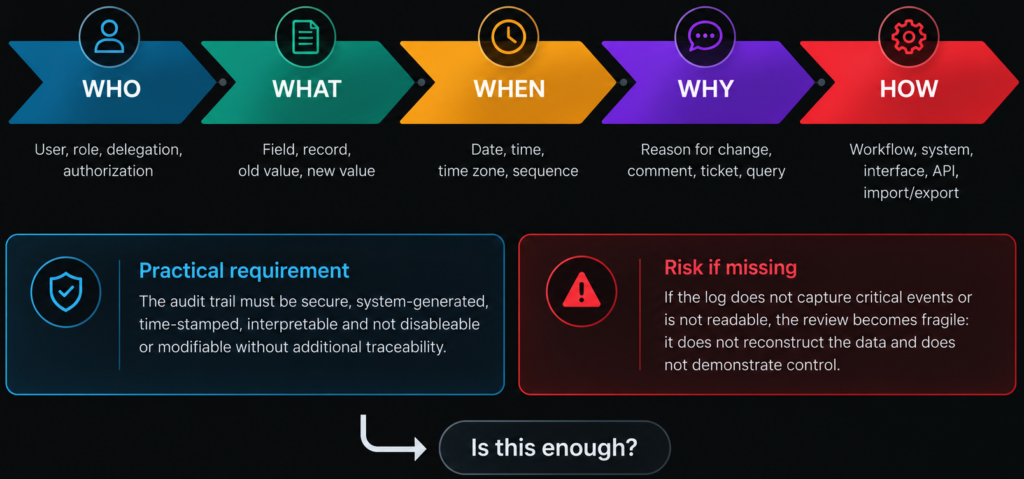
Adapted from my teaching materials on Clinical Data Validation (2026).
MY PERSPECTIVE
From clinical understanding to data governance decisions.
My experience across clinical data management, real-world evidence and healthcare data integration has shaped a practical approach to health data governance.
I start by understanding the clinical context in which data originate, translating requirements into operational controls and considering how information may need to be interpreted, integrated, and reused.
01
Start from clinical meaning
Understand the clinical question, data origin and operational context before defining requirements or selecting technical solutions.
02
Translate requirements into controls
Connect clinical, operational, and regulatory needs to documented specifications, responsibilities, and verifiable quality checks.
03
Design for downstream use
Anticipate integration, interpretation and potential reuse by considering data definitions, provenance and limitations from the outset.
IN PRACTICE · HOSPITAL DATA INTEGRATION
Making heterogeneous clinical data usable across systems.
In a hospital data integration project, information from different clinical databases had to be brought into a coherent structure for cohort identification and analysis.


The challenge extended beyond technical integration: understanding the original clinical workflows, reconciling data definitions and identifying inconsistencies were essential to preserving the meaning of the information.
This experience reinforced my approach to governance: reliable integration starts with clinical understanding and requires documented decisions about data interpretation, transformation and quality.

[1] DAMA International. DAMA-DMBOK: Data Management Body of Knowledge. 2nd ed. Technics Publications; 2017.
[5] Society for Clinical Data Management (SCDM). Good Clinical Data Management Practices (GCDMP©), 2013
[6] Regulation (EU) 2016/679 of the European Parliament and of the Council of 27 April 2016 on the protection of natural persons with regard to the processing of personal data and on the free movement of such data, and repealing Directive 95/46/EC (General Data Protection Regulation), 2016
[7] Regulation (EU) 2025/327 of the European Parliament and of the Council of 11 February 2025 on the European Health Data Space and amending Directive 2011/24/EU and Regulation (EU) 2024/2847