CLINICAL DATA MANAGEMENT
Clinical data are collected. Evidence must be built.
From data collection to reliable clinical evidence.
Clinical Data Management is more than collecting, cleaning and delivering datasets. It translates clinical research requirements into structured, traceable, quality-controlled data processes that support reliable analysis and interpretation [2,4].
My approach combines hands-on experience across clinical studies, data standardisation and digital solutions with a commitment to making complex data management principles understandable and applicable.
Clinical Data
Heterogeneous sources · Clinical observations
Data Quality & Traceability
Structured · Consistent · Verifiable
Reliable Analysis
A stronger foundation for clinical evidence
CLINICAL DATA MANAGEMENT ACROSS THE STUDY LIFECYCLE
Clinical Data Management spans study planning, conduct and closure. Its activities overlap, evolve and require coordination across multiple functions. The six operational stages below provide a structured view of this work, while the timeline illustrates how responsibilities interact throughout the study.
STUDY PLANNING
STAGE 01
Protocol & Data Requirements
Study objectives, endpoints, variables and data specifications.
STAGE 02
Data Collection Design
CRFs, eCRFs, metadata, edit checks and validation plans.
STUDY CONDUCT
STAGE 03
Data Acquisition & Integration
Clinical data capture, external sources and data reconciliation.
STAGE 04
Data Review & Quality Control
Queries, data cleaning, review and discrepancy resolution.
STUDY CLOSURE
STAGE 05
Database Finalisation
Final checks, reconciliation and database lock.
STAGE 06
Analysis-Ready Data & Preservation
Documented data delivery, statistical analysis support and archiving.
Clinical Operation
Data Management
Regulatory activities
Hospital activities
Monitoring
Statistics
Colours identify the functional areas involved in each stage; segment widths do not represent workload or responsibility.
CONTINUOUS PRINCIPLES
Data Quality
Quality built into study design, data collection and review.
Risk Management
Controls proportionate to risks affecting critical data and processes.
Traceability
Documented data origin, transformations and changes.
Change Control
Controlled and documented changes to systems, specifications and data.
These principles apply throughout study planning, conduct and closure. They inform how clinical data are designed, collected, reviewed and managed, rather than representing separate sequential activities. [1, 2, 4]
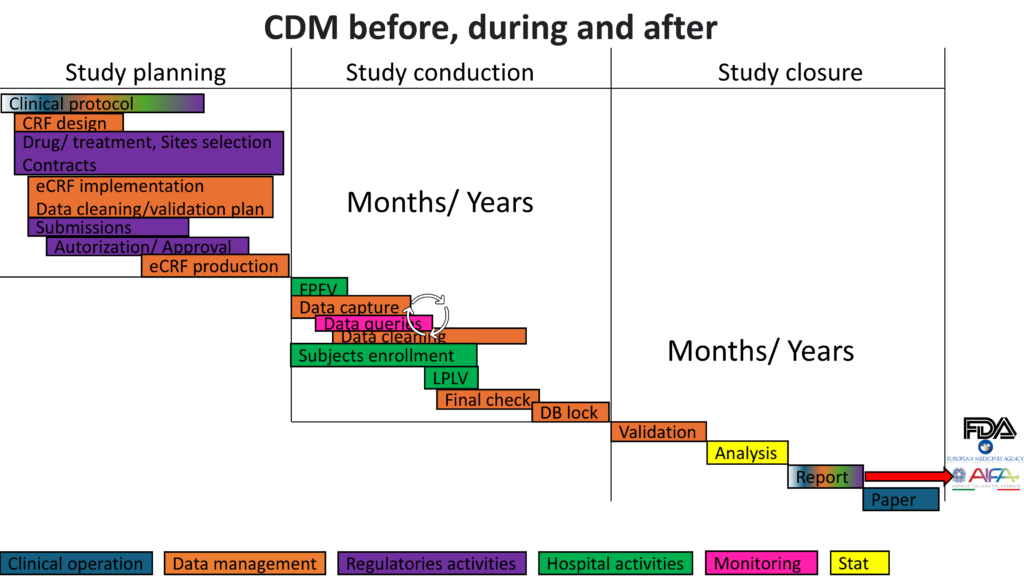
Timeline adapted from the author’s Clinical Data Management teaching materials (University of Milano-Bicocca, MEDAL programme). Illustrative sequence; actual activities and timelines vary by study.
Three lessons from the timeline
01 — Quality starts before enrolment
Protocol review, CRF design, eCRF implementation and data validation planning begin during study preparation, before the first patient is enrolled.
02 — Data review is iterative
Data capture, queries and cleaning overlap during study conduct. Quality control is an ongoing activity, not a single step performed before database lock.
03 — Database lock is not the end of the study
Database lock marks a key data finalisation milestone, while statistical analysis, reporting and other study closure activities may continue afterwards.

FROM PRACTICE TO EVIDENCE
Making clinical data usable in the real world.
Clinical Data Management becomes valuable when sound principles translate into practical solutions. The following examples illustrate how I have addressed clinical complexity, data quality and heterogeneous information across different research settings.
CASE 01 · CLINICAL CONTEXT
Standardising data across multiple clinics
Challenge — Different clinical workflows and data definitions made information difficult to compare across centres.
Action — Worked on a shared data dictionary and the standardisation of clinical variables, aligning data structures with the operational context.
Outcome — Established a more consistent basis for cross-centre data interpretation and subsequent integration.

CASE 02 · QUALITY & TRACEABILITY
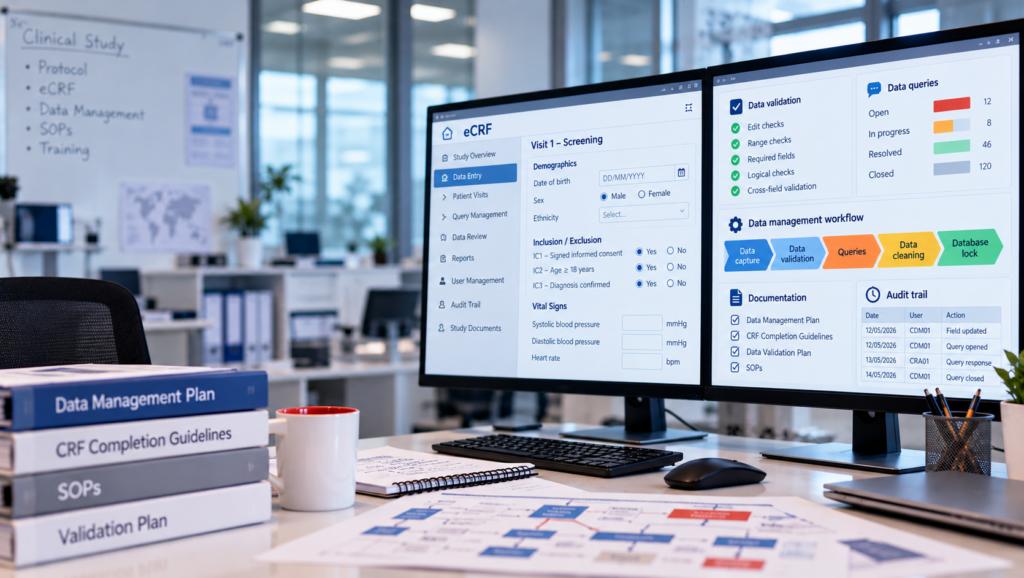
Building structured clinical data processes
Challenge — Clinical research teams needed consistent data collection and documented operational procedures.
Action — Developed eCRF structures, data management procedures, and quality controls for clinical research.
Outcome — Supported more standardised, documented and reproducible data management workflows.
CASE 03 · DATA COMPLEXITY
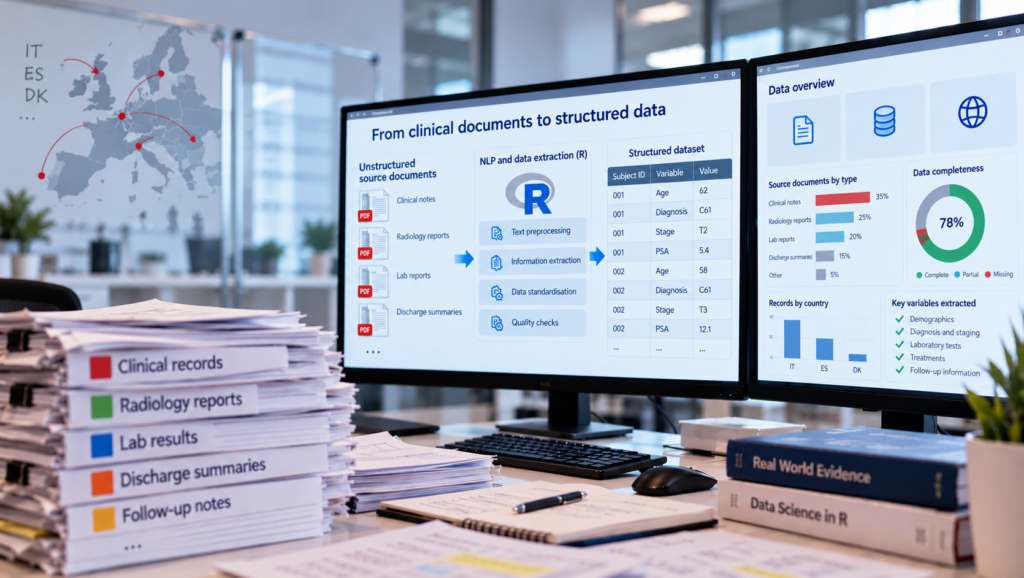
From unstructured clinical documents to structured data
Challenge — Processed approximately 20,000 clinical PDF documents to extract information for a multinational real-world evidence project.
Action — Developed an R-based extraction and processing workflow using text-processing techniques and quality checks.
Outcome — Produced structured information for downstream review and feasibility assessment, while identifying limitations in source-data quality and comparability.